
23 August 2026
Server Cabinet
For an absolute age now, I've wanted to set up some kind of server rack to replace my default pile-of-computers configuration. I want to experiment further with an internet-visible subnet securely separated from my normal home subnet with a robust network monitoring system to spot any undesired behaviour. I don't have any full-size servers, just a bunch of repurposed PCs and thin-clients. So for a usable home-lab I would need to incorporate more machines and the pile-of-computers configuration was becoming burdensome.
I'd found so many designs online and drawn up so many of my own, but I wasn't happy with any of them. They all required too much in the way of materials and I wan't clear enough on my use-cases to be sure they would suit. I hate the situation where I've spent a load of money on materials and I'm halfway through building when I realise I've made a critical design screw-up and will have to start again.
This summer's weather has also been stupidly hot and my computer room unbearably so. I figured the 24-7 pile-of-computers was partly to blame, so I started looking at extractor fans and how to fit them. I spotted a fairly decent inline extractor kit for around £100 and figured I could wire it up to a mains plug, rather than messing with the actual lighting electrics.
So with ideas beginning to fall into place and having an unrelated need for a trip to Ikea, I decided to measure up my machines just in case an easy Ikea-hack presented itself. Luckily enough it did, in the shape of the Rast chest of drawers. I checked it was solid pine so I wouldn't have any honeycomb cardboard surprises when I cut into it, and whilst the drawer runners wouldn't be useful I could just make timber runners and convert the drawers into trays.
After much scribbling, cutting, screwing and swearing, I managed to hack together this:
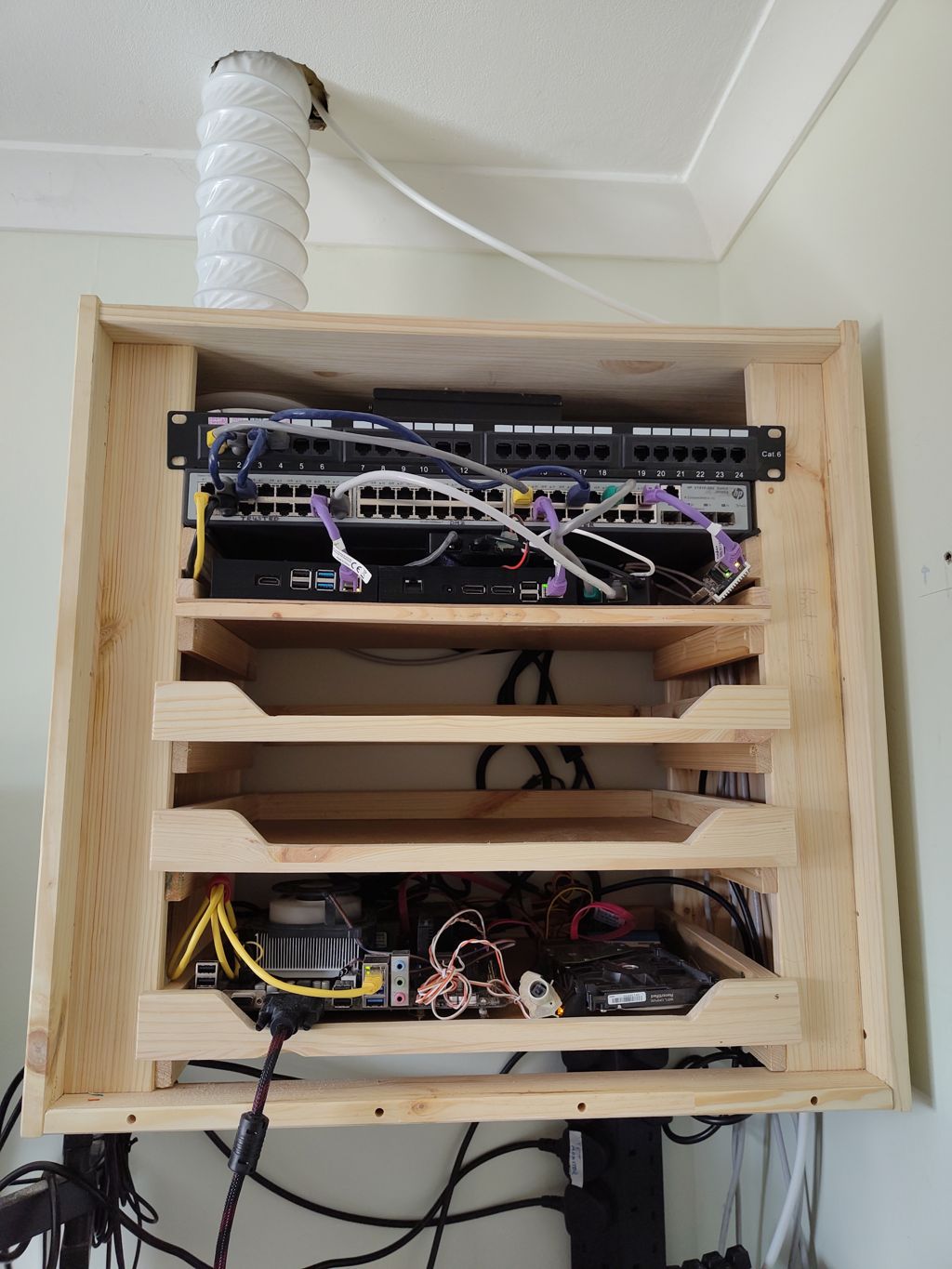
None of the trays slide as nicely as I wanted them to, but it's not like I'm going to be pulling them out very often. I've got a single 850W ATX PSU at the top which powers the switch and all the 5V machines on the top tray. I have a few 12V thin clients not yet on the middle trays which will also draw power from it. The bottom tray is an old PC with its own silent power supply. The plug sockets for them all are mounted on the wall in the bottom-right of the photo. I have a second plug extension out of shot with a switch on each plug. The extractor is plugged into that so I can easily switch it on or off as needed.
Fitting the extractor in the loft was seriously hot work. Hacking the permanent-live/switched-live to a single mains-cable-live was hampered by the fan's terminal blocks being so damned small, but there was enough space in the casing to wedge in a separate electrical connector strip to split out the mains-cable-live into two. With the actual fan up in the attic, it's less noisy than the computer fans themselves and it's made a huge difference to the ambient temperature in the room. (Just in time for the summer heat to break :/)
Anyway, I'm really pleased with it. Now I can get back to building my network-monitoring system properly and investigate VPN software, Nextcloud/TinyCld, CloudFlare proxies and all the rest. :)